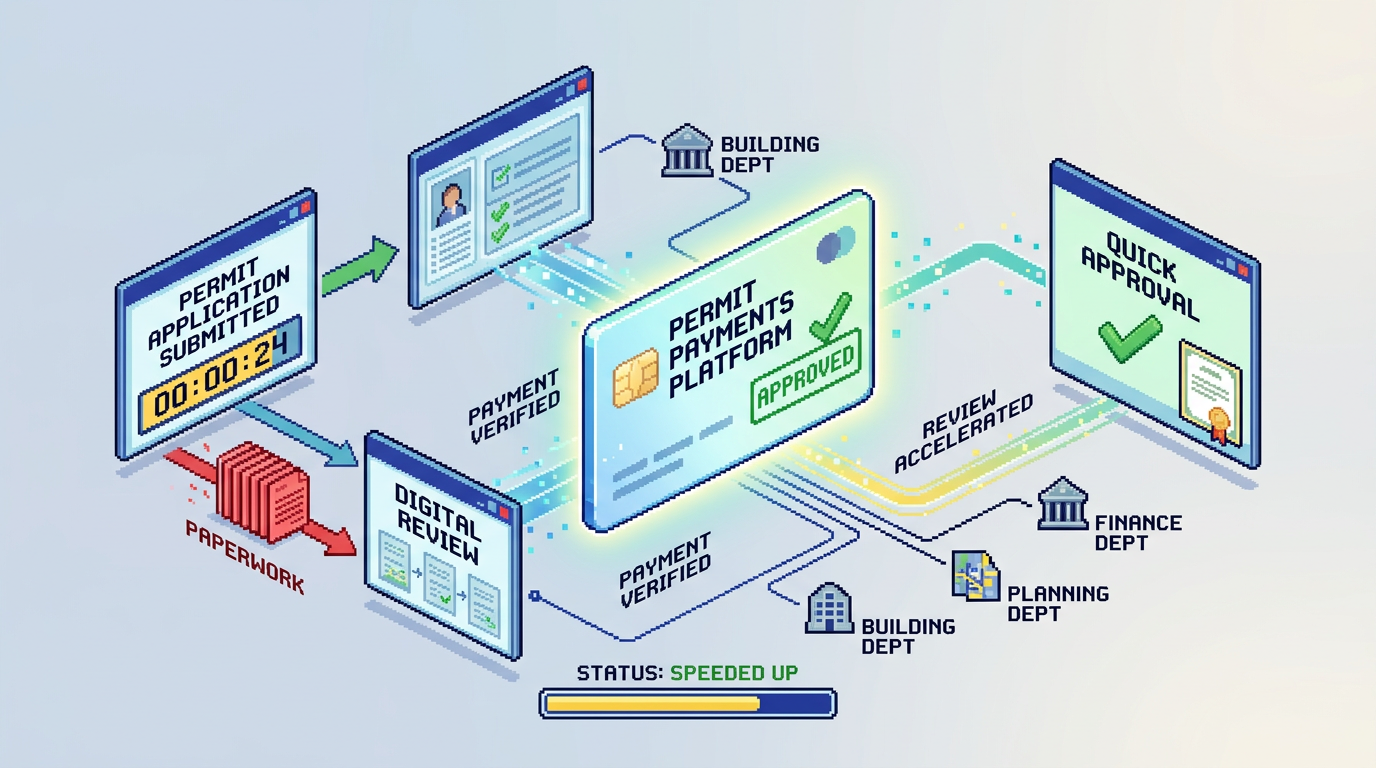
Municipal permitting teams are under pressure to do more with less. Applicants expect clear timelines, predictable fees, and online convenience, while staff juggle compliance checks and cross‑department routing.
This guide shows how a permit payments platform, paired with AI auto‑triage and rule‑based auto‑approval, shortens review cycles without adding headcount. It is written for planning, building, and zoning leaders seeking measurable gains in speed, compliance, and accountability. Key takeaway: integrate payments with intake, AI document analysis, and audit trails to cut backlogs while strengthening oversight.
Why payments belong inside your permitting workflow
Modernizing payments is not only about convenience. When payments sit inside the same system as intake, routing, and compliance checks, you eliminate handoffs that delay approvals.
The true cost of off‑platform payments
External portals create mismatched records, slow reconciliations, and manual status updates. These gaps often stall reviews even when technical checks are complete.
Revenue recognition tied to milestones
Linking fees to review milestones ensures the right personnel and steps are triggered on time. Staff gain clarity on what is paid, pending, or refundable.
From intake to decision: a unified flow with AI assist
A unified platform connects applicant actions, departmental reviews, and finance. AI permitting software assists by extracting compliance data from plan sets and flagging risks before staff touch the file.
AI document analysis that reduces rework
Tools can parse PDFs and DWGs to pull setbacks, lot coverage, and height. Early warnings help applicants fix issues before fees are paid or reviews start, improving first‑time completeness.
Smart routing and rule‑based auto‑approval
Auto‑triage assigns files to the right department. For low‑risk permits configured by policy, auto‑approval can issue decisions after checks pass and required fees clear.
Designing fees and rules that drive predictability
Clear fee logic aligned to by‑law triggers reduces disputes and back and forth. Combine rule definitions with payment events so the system can enforce them consistently.
Map fee schedules to policy
Document which fees apply by permit type, project size, and zoning. Encode those parameters so the platform computes amounts automatically.
Attach payment gates to review steps
Configure when intake, plan review, inspection, and issuance fees are due. Tie each gate to a status change so staff and applicants see clear next steps.
Compliance and auditability without added burden
Municipal leaders need confidence that speed does not weaken oversight. The right system deepens accountability while moving faster.
End to end audit trail
Every action is logged, from document uploads to status transitions and fee receipts. Auditors can reconstruct decisions without chasing email threads.
Role based controls and data residency
Granular permissions protect sensitive data. For Canadian municipalities, hosting in Canada Central with AES‑256 at rest supports regulatory alignment.
What a permit payments platform should include
Use this checklist to evaluate solutions that connect payments with intake, AI checks, and approvals.
Core capabilities to require
- Integrated invoicing and receipting tied to application IDs
- Support for application, review, inspection, and issuance fees
- Applicant self serve payments and refunds with status sync
- AI by‑law and zoning compliance extraction from plan sets
- Rule based auto approval for eligible, low risk files
- Complete audit trail and activity timeline
Applicant and staff experience
- Drag and drop uploads for PDF, DWG, JPG up to practical size limits
- Live status with departmental assignment and notifications
- Change request handling without leaving the application
- Accessible payment history and downloadable receipts
Payments and change management go hand in hand
Adjustments during review are common. Treat change requests and fees as one managed process inside the platform.
Scoped changes with fee impacts
When scope shifts increase valuation or coverage, the system should recompute fees, present deltas, and collect payment before the next review step.
Transparent refunds and credits
If an application is withdrawn or downscoped, staff can issue partial refunds or credits while preserving a clear audit record.
Measuring impact: from backlog to cycle time
Adopt metrics that link payments, AI checks, and routing to outcomes that councils and the public value.
Leading indicators to track
- First pass completeness rate
- Average time from submission to first reviewer assignment
- Share of permits auto approved within policy
- Percentage of payments collected without staff intervention
Outcome metrics for accountability
- Median approval time by permit type
- Backlog age distribution
- Fee reconciliation accuracy and time to close month end
- Inspection scheduling lead time
Security, compliance, and public trust
Modernization must meet municipal security expectations while protecting resident data.
Encryption and access controls
Encrypt data at rest and in transit, enforce strong authentication, and apply least privilege permissions across roles.
Canadian data residency considerations
For Canadian municipalities, store and process data in Canada to align with procurement and policy requirements.
Example workflow: low risk deck permit
This scenario illustrates how integrated payments and AI checks accelerate a common residential permit while keeping a complete record.
Intake and AI pre check
- Applicant uploads site plan and elevations. The system extracts front setback, lot coverage, and proposed height.
- Results display as Pass for setbacks and lot coverage, and a height warning if close to the limit. Applicant corrects before submission.
Fees, routing, and decision
- Intake fee is auto calculated and paid online.
- Auto triage assigns Zoning Check to Planning.
- With all checks green and rules configured, the permit is auto approved and the issuance fee is collected.
Comparing permitting payment approaches
The table below contrasts fragmented payments versus an integrated permit payments platform.
| Approach | Data accuracy | Cycle time impact | Staff effort | Audit readiness |
|---|---|---|---|---|
| Separate finance portal | Low due to re entry | Slower from handoffs | High for reconciliation | Limited, scattered records |
| Permit payments platform | High with single source | Faster with gates and sync | Lower via automation | Full timeline and receipts |
How PermiPro supports municipalities
PermiPro is an AI first municipal permit management software platform built to connect intake, compliance checks, routing, payments, and audit trails in one place.
AI and workflow automation
- AI extracts zoning and by law data such as setbacks, lot coverage, and height from PDFs and DWGs
- Smart auto triaging assigns to the right department
- Rule based auto approval for eligible, low risk permits
Payments, status, and accountability
- Integrated permit payments platform with receipting and refunds
- Live status tracking, applicant change requests, and email notifications
- Comprehensive audit trail and granular role based permissions
Implementation tips for change leaders
A successful rollout pairs technology with clear policy and training.
Start with a focused pilot
Choose a high volume, low risk permit type to pilot AI checks and auto approvals. Measure cycle times and error rates before expanding.
Align rules and communications
Publish eligibility criteria, fee schedules, and service timelines. Train staff and applicants on how gates and auto approvals work.
Procurement checklist for platform selection
Use this list to structure RFPs and demos.
Functional requirements
- AI permitting software that performs permit document analysis
- Integrated payments with milestone gates and refunds
- Departmental assignment and status automations
- Change request flows tied to fee deltas
Non functional requirements
- AES 256 encryption at rest and TLS in transit
- Canadian data residency with Canada Central availability
- Role based access controls and detailed logging
- Vendor support for training and migration
Key Takeaways
- A permit payments platform linked to AI checks, routing, and audit trails shortens review cycles without adding staff
- Rule based auto approval works when eligibility, fees, and gates are encoded and visible to applicants
- Integrated change requests prevent scope and fee mismatches during review
- Security features and Canadian data residency build trust and aid procurement
Modernizing payments inside a unified permitting system delivers speed, clarity, and accountability for both staff and applicants.