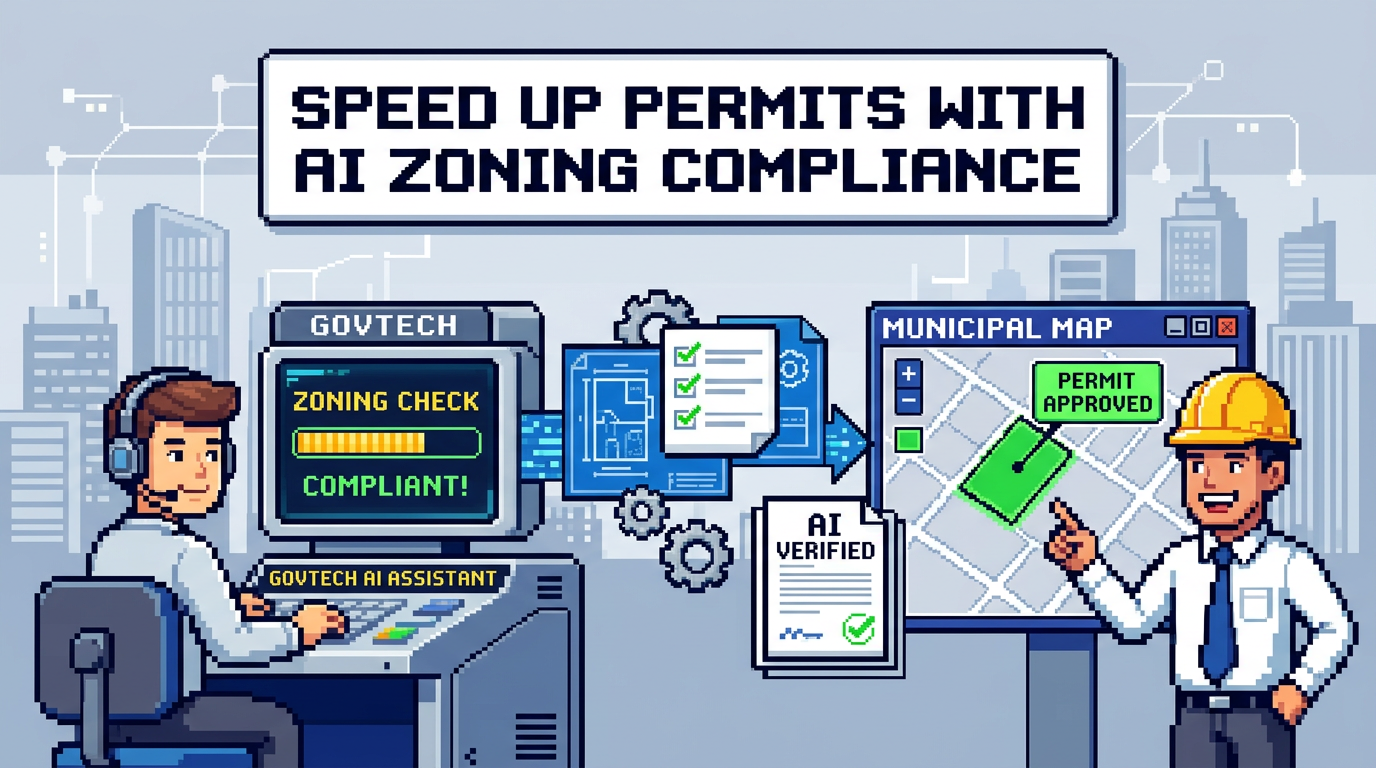
Municipal backlogs do not happen overnight, and they rarely clear themselves. The fastest wins often come from standardizing intake and verifying zoning earlier, with clear results that staff and applicants can trust.
This guide explains how AI zoning compliance works, who benefits across planning and building teams, and how to design safe auto-approval for low risk permits. It is written for municipal departments evaluating digital building permitting and AI permitting software. The key takeaway: start with AI assisted zoning checks and rule based auto triage to cut queue time while strengthening accountability.
What is AI zoning compliance and why it matters
AI zoning compliance applies machine learning and structured rules to read plan sets and compare extracted values to your by laws. It targets repetitive checks like setbacks, lot coverage, and height, which consume reviewer time and are prone to manual errors.
Core definition
AI zoning compliance is the automated extraction of zoning relevant data from documents like PDFs and DWGs and the comparison of that data to codified municipal standards. The output is a pass, fail, or warning with citations and evidence.
Typical inputs and outputs
Inputs include site plans, elevations, and application forms. Outputs include numeric findings, rule evaluations, and a clearly logged decision trail that shows what was checked and why.
Why it matters now
Applicant volumes are rising while staff hiring lags. Automated first pass checks reduce rework, improve first time completeness, and give applicants faster feedback without sacrificing control.
How AI zoning compliance works in municipal workflows
Understanding the end to end path clarifies where time is saved and where safeguards belong.
Intake and document capture
Applicants upload required files through a portal with drag and drop support for formats like PDF, DWG, and JPG. Metadata such as address and zoning district is captured to anchor the ruleset.
Extraction and normalization
The system parses drawings to identify dimensions like front setback or building height, normalizes units, and associates measurements with parcels and features. Confidence scores flag uncertain extractions for human review.
Rule evaluation
Configured rules map by law text into machine readable checks. For example, R1 front setback min 6 m becomes an evaluator that compares the extracted value against 6 m and records pass, fail, or near limit warning.
Results, triage, and routing
Low risk, fully compliant applications can be auto triaged for fast track or auto approval, while ambiguous or failing cases route to planning or building reviewers with highlighted issues and evidence.
Designing safe rule based auto approval
Auto approval should target simple, low risk scenarios with unambiguous standards. Good design reduces manual burden without compromising public safety or due process.
Eligibility criteria
Define permit types and districts where standards are clear, such as small decks, sheds, or minor accessory structures. Require complete documents and high extraction confidence before considering auto approval.
Guardrails and thresholds
Use near limit warnings to keep borderline cases out of auto approval. For example, if the height is within 0.2 m of the maximum, route for review even if technically compliant.
Auditability and transparency
Every automated decision must produce a human readable log. Include the rule text, the extracted measurements, timestamps, and the identity of the ruleset version used.
Building your ruleset from by laws
The quality of your AI zoning compliance depends on the clarity of your rules. Start small, codify consistently, and iterate as reviewers provide feedback.
Scoping and prioritization
List the highest volume checks that slow reviews. Common starters are setbacks, lot coverage, and height. Limit phase one to rules with clear numeric thresholds and minimal exceptions.
Translating by law text
Break each standard into measurable conditions with units and districts. Include exception handling as separate checks to avoid hidden logic inside a single rule.
Version control and testing
Maintain versions of your rules with effective dates. Test on historical applications to validate outcomes and calibrate warning thresholds before production use.
Implementing AI zoning compliance step by step
A structured rollout aligns expectations and reduces risk.
Phase 1: Assistive checks only
Begin with read only AI findings inside the reviewer queue. Measure accuracy, time saved on pre screening, and the rate of applicant resubmissions.
Phase 2: Auto triage by risk
Introduce routing rules that send clearly compliant applications to fast track review while flagging uncertain or failing cases to specialists. Keep humans in the loop for final decisions.
Phase 3: Limited auto approval
Enable auto approval for a narrow set of low risk permits with strong documentation requirements, clear rules, and robust audit logs. Expand only after monitoring results.
Measuring impact and reporting outcomes
Select metrics that reflect both speed and quality. Pair time savings with compliance and transparency indicators.
Throughput and timelines
Track median days from submission to decision for eligible permit types. Monitor queue time reductions after auto triage is enabled.
First time completeness
Measure the percentage of applications that pass initial zoning checks without resubmission. Rising completeness indicates clearer guidance and effective pre screening.
Review effort
Estimate reviewer minutes per application before and after AI assisted checks. Focus on repetitive measurements replaced by extraction.
Accountability and audit activity
Review the number of actions logged per file and the frequency of rule version references in decisions. Strong logs simplify internal audits and public records requests.
Integrating payments, change requests, and status updates
Speed gains compound when applicants can act quickly on feedback and fees.
Integrated payments
Collect zoning and permit fees within the same system so approvals are not delayed by off platform steps. Provide receipts and reconcile revenue by permit type.
Applicant change management
Allow applicants to submit revised drawings directly against requested changes. Preserve a clear timeline that shows what changed and when.
Live status tracking
Expose status states such as Submitted, Review, and Approved with departmental assignments so applicants and staff see progress without phone calls.
Security, residency, and permissions for municipal use
Public trust depends on data handling as much as speed.
Encryption and residency
Store files with strong encryption at rest and comply with Canadian data residency when required. Confirm hosting region and backup locations in vendor documentation.
Role based access control
Configure granular permissions so only authorized staff can view, edit, approve, or delete records. Align roles to job functions across planning, building, and finance.
Notifications and inspections
Use email notifications for inspections, new applications, and payments to keep stakeholders informed without manual outreach.
Practical examples of AI zoning checks
These scenarios illustrate how automated checks present results to reviewers.
Setbacks and lot coverage
A residential deck permit is uploaded with a site plan. The system extracts front setback at 6.2 m and lot coverage at 32 percent. Both pass against the district rules and the file is flagged low risk.
Height near the limit
An elevation shows proposed height at 9.1 m with a district maximum of 9.5 m. The result is compliant with a near limit warning. The application routes to a planner for a quick confirmation.
Missing or ambiguous data
If a plan lacks a clear scale bar or dimension labels, the extraction confidence drops. The system requests a revised drawing and pauses automated evaluation until resubmission.
Vendor selection checklist for AI permitting software
Use these criteria to compare municipal permit management software options for zoning automation.
Evaluation criteria
- Accuracy on your document types and scales
- Configurable rules with version control
- Audit trail granularity and export options
- Integrated payments and change requests
- Canadian data residency and encryption details
- Role based permissions and departmental routing
Quick comparison of common capabilities
The table below summarizes capability categories to review during procurement.
| Capability | AI zoning checks | Auto triage | Auto approval | Payments | Audit trail | Data residency |
|---|---|---|---|---|---|---|
| Importance | High | High | Medium | Medium | High | High |
| What to ask | Accuracy on your plans | Risk rules | Guardrails | Reconciliation | Log detail | Region and backups |
| Proof needed | Pilot results | Workflow demo | Policy review | Reports | Export sample | Contract terms |
How PermiPro supports AI zoning compliance
PermiPro is designed for municipal teams seeking faster, accountable reviews with Canadian data residency.
Document analysis and findings
Upload PDFs, DWGs, and JPGs up to 50 MB. AI extracts zoning metrics like setbacks, lot coverage, and height, then records pass, fail, or warning with context in the activity timeline.
Smart routing and auto approval
Configure auto triage rules so low risk, compliant files move to fast track or auto approval. Near limit warnings push files to human review to preserve safety margins.
Integrated payments and change requests
Accept payments in platform, issue receipts, and let applicants submit revisions tied to specific requests. All actions appear in a comprehensive audit trail.
Security and residency
Data is encrypted at rest with AES 256 and hosted in Canada Central. Granular permissions and real time notifications help maintain control and transparency.
Getting started with a pilot
A focused pilot reduces risk and builds stakeholder confidence.
Define scope and success metrics
Choose two high volume permit types and a small reviewer cohort. Target measurable reductions in queue time and resubmission rates.
Prepare sample files
Assemble recent approved and rejected applications to validate extraction and rule behavior. Include edge cases near limits.
Train staff and iterate
Provide short training on reading AI findings, adjusting rules, and logging reviewer notes. Iterate weekly based on accuracy and throughput data.
Key Takeaways
- Start with AI zoning compliance on clear, numeric standards to unlock fast wins.
- Use rule based auto triage before limited auto approval to manage risk.
- Pair speed metrics with audit and transparency measures for accountability.
- Integrate payments and change requests to prevent new bottlenecks.
- Require encryption, data residency, and role based permissions from vendors.
Adopt AI assisted zoning checks in phases and you will shorten timelines while strengthening trust in every permit decision.