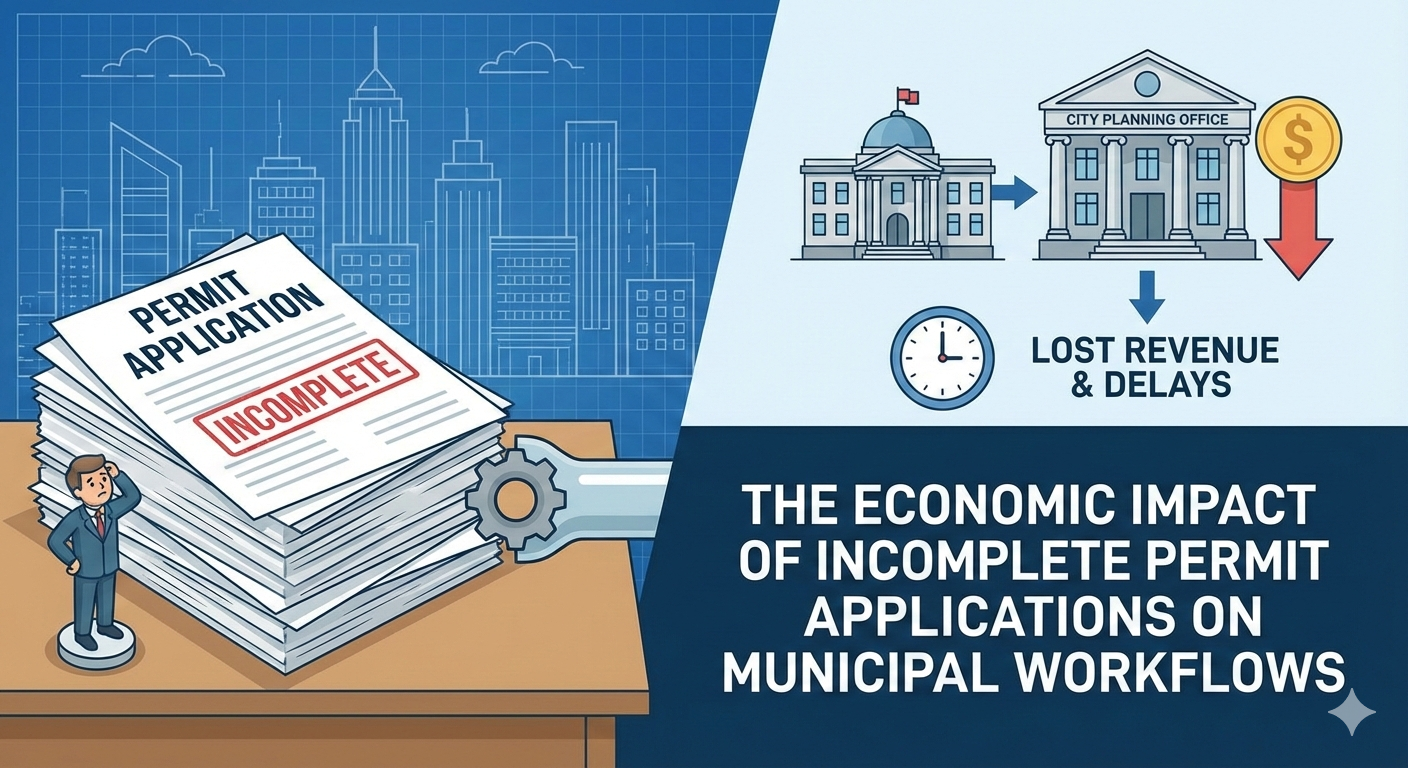
The Economic Impact of Incomplete Permit Applications on Municipal Workflows
For many Canadian municipalities, the permitting process begins with a significant hidden cost. When a resident or developer submits an application that lacks required documents or contains incorrect information, the administrative clock starts ticking before any actual review takes place. This administrative churn creates a cascade of inefficiencies that impact the entire organization.
The challenge is not just a matter of paperwork. It is a financial and operational burden that slows down housing starts and infrastructure projects, directly affecting the municipal bottom line and the local economy.
The High Cost of Manual Triage
The current approach in many municipalities relies on manual triage. Administrative staff must spend valuable hours reviewing submissions just to ensure they are complete. When a file is missing a site plan or an authorization form, the staff must contact the applicant, wait for a response, and then re-evaluate the file.
This back and forth process often happens multiple times for a single application. For a planning department handling hundreds of permits a month, these minutes turn into days of lost productivity. The cost of this manual intervention is often unrecovered, as permit fees are typically structured around the technical review rather than the administrative cleanup.
Operational Consequences of Fragmented Data
Incomplete applications do more than just waste time. They introduce fragmented data into the municipal system. When staff members attempt to track missing information through email chains or sticky notes, the municipal record becomes unreliable.
This lack of data integrity has several consequences:
- Resource Drain: Highly skilled building inspectors and planners spend time on clerical follow ups instead of technical reviews.
- Reduced Visibility: Leadership cannot accurately project revenue or timelines because the "active" queue is filled with stalled applications.
- Compliance Risks: If a permit is issued based on incomplete or outdated information that was added later in a disorganized fashion, the municipality faces increased liability.
Impact on Timelines and Public Trust
From the perspective of a developer or homeowner, a delay is a delay. They often do not distinguish between the time spent waiting for a provincial approval and the time spent waiting for a staff member to tell them they forgot a signature.
Extended wait times lead to increased frustration and a negative perception of municipal efficiency. When the process is perceived as a "black hole," it discourages local investment. Furthermore, as provincial mandates for faster housing approvals increase, the inability to process applications efficiently becomes a significant political and regulatory risk for municipal leadership.
Shifting from Manual Review to Digital Validation
Modern municipal permitting software changes the fundamental dynamic of the intake process. Instead of allowing an incomplete application to enter the system, digital platforms use validation rules to act as a gatekeeper.
If a required field is empty or a mandatory attachment is missing, the system prevents the user from submitting. This shifts the responsibility of completeness back to the applicant. The result is that every file reaching a staff member's desk is "review ready." This single change can reduce administrative touchpoints by up to 80 percent.
The Canadian Municipal Context
In Canada, municipalities are under immense pressure to accelerate housing delivery while managing tight budgets. With rising labor costs and a competitive market for skilled planners, maximizing the efficiency of existing staff is a priority.
Moving away from paper based or legacy digital systems that allow incomplete submissions is no longer just a "nice to have" improvement. It is a necessary step for fiscal responsibility and meeting provincial growth targets.
Where PermiPro Fits In
PermiPro is designed specifically to solve the "incomplete application" problem for Canadian municipalities. Our platform provides a clear, guided experience for applicants, ensuring that no submission can be finalized without meeting the specific requirements of your bylaws.
By automating the intake and validation process, PermiPro allows your planning and building departments to focus on high value tasks. We provide the tools to track every step of the workflow, offering CAOs and Directors the data they need to optimize operations and demonstrate transparency to the community.
Book a Demo
Discover how PermiPro can streamline your municipal permitting and reduce the economic impact of administrative churn.