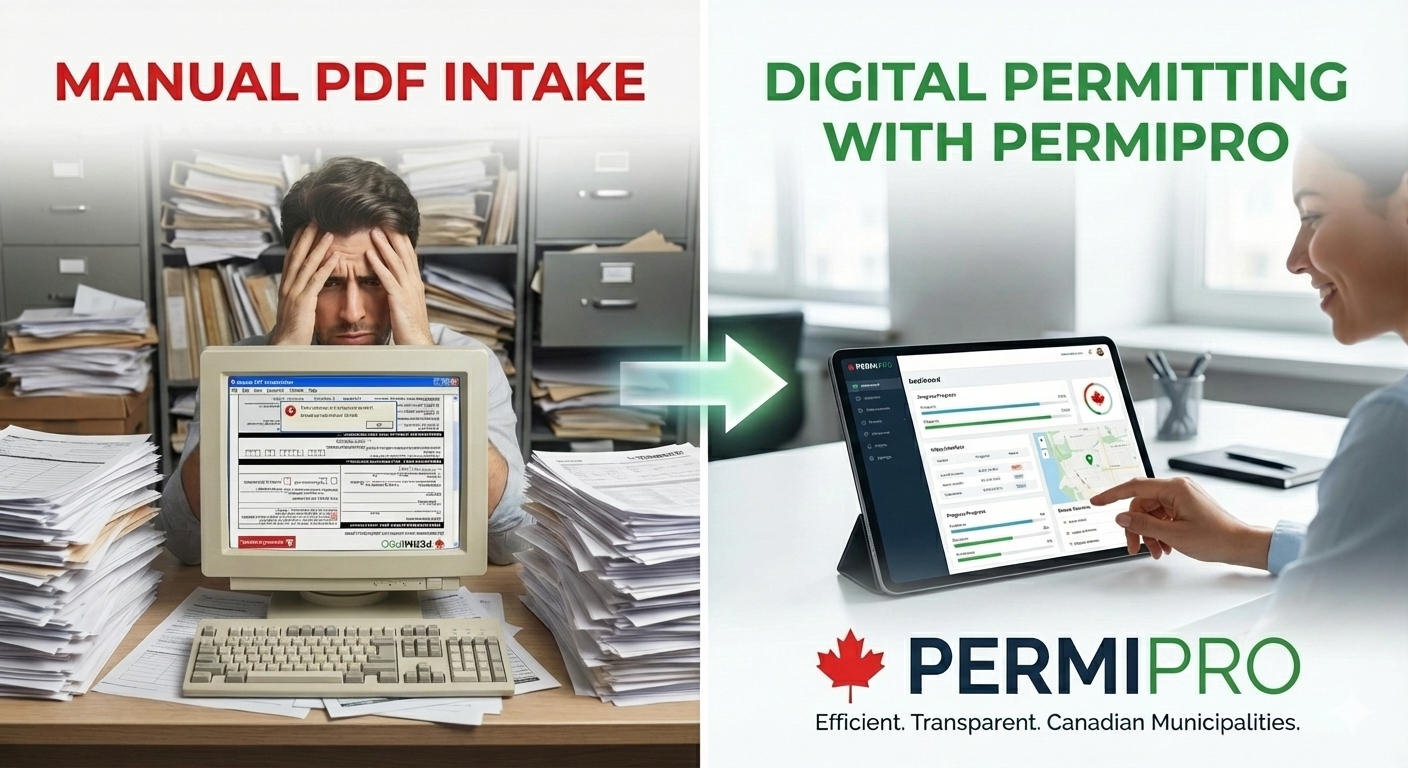
Transitioning from Manual PDF Intake to Digital Permitting in Canadian Municipalities
For many Canadian municipalities, the first step toward digitization was moving from paper applications to fillable PDF forms sent via email. While this eliminated the need for physical storage and postage, it created a new set of bottlenecks that often go unnoticed until the volume of applications increases.
Moving from manual PDF intake to a dedicated online permitting system represents a fundamental shift in how a municipality operates. It moves the department from a reactive state of document management to a proactive state of process management.
Why the PDF Approach Fails to Scale
The primary issue with PDF based intake is that the data remains trapped inside the document. When an applicant emails a PDF, a staff member must manually extract that information and enter it into a spreadsheet or a legacy database.
This process is prone to human error and creates a significant delay between the moment an application is submitted and when the review actually begins. Furthermore, PDFs do not allow for real time validation. If an applicant misses a required field or provides an incorrect property identifier, the error is only caught days or weeks later during the initial intake review.
Operational Consequences of Manual Intake
The reliance on manual workflows has measurable impacts on municipal resources:
- Administrative Overhead: Staff spend roughly 30 to 40 percent of their time on data entry and document sorting rather than technical reviews or site inspections.
- Lack of Transparency: Applicants often call or email the planning department for status updates because they have no visibility into where their application sits in the queue.
- Fragmented Communication: Feedback and revision requests are often buried in individual staff email inboxes, making it difficult to maintain a consistent record for the property file.
- Security and Retention Risks: Managing sensitive documents through email poses security risks and makes it difficult to adhere to provincial record retention bylaws.
How Modern Permitting Software Changes the Workflow
A transition to an online permitting platform changes the intake process from a "push" model to a "pull" model. Instead of receiving a file, the municipality provides a structured portal where the data is validated before the applicant can even click submit.
Modern systems ensure that all required documents are attached and all mandatory fields are completed. This results in "front ending" the effort, ensuring that by the time a file reaches a planner or building official, it is complete and ready for review. This shift significantly reduces the "back and forth" that typically plagues the early stages of the permitting lifecycle.
The Canadian Context: Legislative Pressures
Across Canada, provincial governments are introducing stricter timelines for housing approvals. In Ontario, Bill 23 and subsequent updates have placed immense pressure on municipalities to process applications faster or face fee refund penalties. In British Columbia, new housing statutes require similar accelerations in local government approvals.
Manual PDF processes are no longer fast enough to meet these legislative requirements. Digital systems provide the tracking and reporting necessary to ensure that statutory deadlines are monitored and met, protecting the municipality from financial and legal risks.
Where PermiPro Fits In
PermiPro provides a structured environment for Canadian municipalities to move away from fragmented PDF workflows. Our platform centralizes application intake, internal reviews, and communication in a single, cloud based interface.
By focusing on a clean, intuitive user experience for both staff and applicants, PermiPro reduces the learning curve associated with digital transformation. The system is designed to handle the specific complexities of Canadian municipal bylaws and zoning requirements without the need for extensive custom coding.
Book a Demo
If your municipality is looking to move beyond email and PDFs to a more efficient, transparent permitting process, we invite you to learn more.