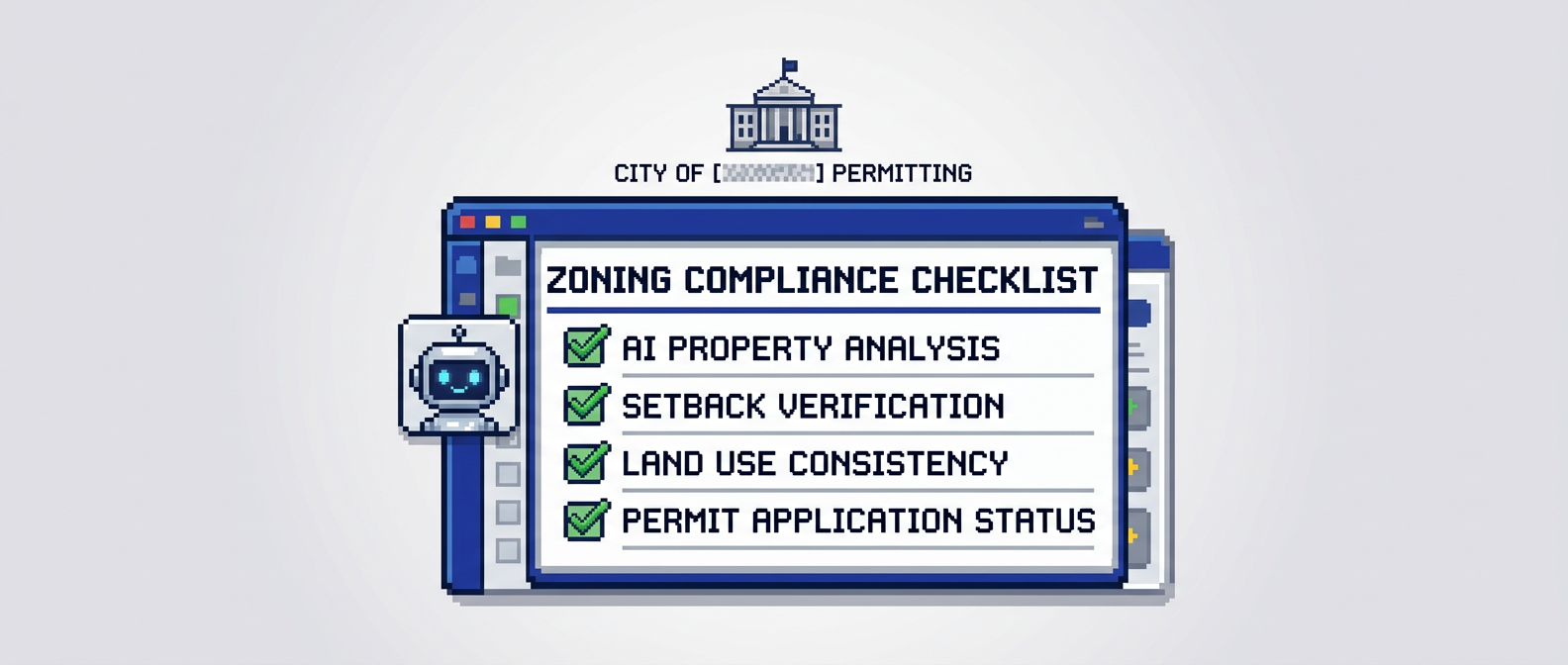
Municipal permitting teams are under pressure to move faster without sacrificing accuracy or accountability. AI zoning compliance is becoming a practical way to speed reviews, catch issues earlier, and keep a clean record for public trust.
This post gives permitting leaders and reviewers a step by step checklist to evaluate and implement AI zoning compliance as part of digital building permitting. You will learn what to assess in data, rules, workflows, payments, and security, with safeguards for auto approval. The key takeaway: start with low risk permits, codify clear rules, and pair AI analysis with an audit trail to cut cycle times and improve consistency.
Define scope and outcomes for AI zoning compliance
Clarity on goals and constraints sets the foundation for success.
Choose initial permit types and risk tiers
- Start with low complexity permits such as decks, fences, sheds, rooftop solar, HVAC swaps, or minor interior alterations.
- Define what qualifies as low risk using thresholds like maximum area, height, or proximity to lot lines.
- Document exclusions that must always go to manual review, such as heritage properties or floodplain overlays.
Set measurable success metrics
- Target reductions in average review time and backlog size for the selected permit types.
- Track first pass completeness rates and the proportion of auto triaged applications.
- Monitor variance between AI extracted values and reviewer verified values to refine models and rules.
Establish guardrails for decision authority
- Define which checks AI can perform for draft recommendations versus final decisions.
- Require human review for edge cases identified by thresholds or model confidence.
- Record authority boundaries in your standard operating procedures and staff training material.
Prepare zoning and by law rules for automation
Codified and testable rules are the backbone of AI assisted decisions.
Normalize zoning text into structured logic
- Translate setbacks, lot coverage, height, parking, and use permissions into machine readable rules with clear units and exceptions.
- Capture overlay zones, corner lots, and special districts as layered conditions.
- Version rule sets with dates, references to by law sections, and change notes.
Define pass, warn, and fail thresholds
- Use pass when values clearly meet requirements.
- Use warn for near limits to prompt human review, for example proposed height at 9.1 m against a 9.5 m maximum.
- Use fail when requirements are definitively missed and return specific citations to the applicant.
Map rules to required documents
- For each check, define which files or plan sheets supply the needed data.
- Require standard naming for uploads to improve extraction accuracy, such as Site_Plan_Final.pdf or Elevation_North.dwg.
- Allow JPG or PDF for photos and receipts while keeping vector formats like DWG for precise dimensions.
Build the data and document pipeline
AI zoning compliance depends on reliable inputs and traceable outputs.
Standardize intake with clear file guidance
- Provide a checklist in the portal for mandatory and optional uploads.
- Support drag and drop of PDF, DWG, and JPG up to the size limits your system enforces, such as 50 MB.
- Validate file presence and basic metadata before submission to reduce incomplete applications.
Enable AI powered document analysis
- Extract key values from uploaded plans: front setback, side yard, lot coverage percentage, and proposed height.
- Surface the extraction side by side with the source page and measurement context for reviewer verification.
- Log the extracted value, method, and confidence for auditability.
Create a durable data model
- Store normalized measurements with units, coordinate references where relevant, and the source document pointer.
- Link each extracted datum to the specific rule it satisfies or violates.
- Maintain change history when applicants upload revisions.
Design smart triage and auto approval rules
Consistent routing and safe automation shorten queues and protect quality.
Auto triage based on rule outcomes and metadata
- Route compliant, low risk applications directly to issuance or final check.
- Assign conditional reviews to Planning or Zoning teams when warnings or overlays are detected.
- Escalate to senior reviewers for fails or complex parcel contexts.
Configure rule based auto approval for narrow cases
- Permit immediate issuance when all checks pass, fees are paid, and no overlays apply.
- Require a timed cooling period or spot check sampling if policy mandates oversight.
- Always record the rule set and version used to approve.
Monitor and tune with feedback loops
- Track override rates where reviewers change AI recommendations.
- Analyze patterns in warnings that frequently convert to passes or fails and adjust thresholds.
- Publish periodic reports to leadership on cycle times, accuracy, and exceptions.
Integrate payments, receipts, and change requests
Tying financials and applicant updates into the same workflow reduces handoffs.
Streamline fee calculation and collection
- Calculate fees based on project attributes captured at intake.
- Accept payments in portal with receipts and reconcile in a payments dashboard that shows paid and pending.
- Block issuance on unpaid balances while allowing pre review for planning checks if policy allows.
Manage applicant revisions cleanly
- Let applicants submit change requests that attach revised documents and a reason.
- Preserve the previous version in the file timeline and note any new extractions.
- Re run only the affected checks to speed re review.
Keep applicants and staff in sync
- Provide live status tracking such as Submitted, Review, and Approved.
- Send real time email notifications for inspections, payments, and required actions.
- Offer a clear history so applicants can self serve basic questions.
Establish auditing, transparency, and permissions
Public accountability requires complete records and role appropriate access.
Maintain a comprehensive activity timeline
- Log every status change, document upload, extraction event, and decision with timestamps and user roles.
- Include system generated validations such as document verification steps.
- Allow export for public records requests and internal audits.
Use granular role based permissions
- Restrict who can view applications, approve permits, or delete records.
- Separate duties so the same user cannot both configure rules and approve resulting permits.
- Review permission assignments quarterly and after staffing changes.
Provide explainability for AI decisions
- Show the rules applied, the extracted values, and the final pass or fail outcome.
- Link to relevant by law sections so reviewers can confirm context.
- Capture reviewer notes when overrides occur for future training and policy updates.
Security, residency, and compliance considerations
Protecting resident data and aligning with jurisdictional requirements is non negotiable.
Encrypt data at rest and in transit
- Use strong encryption such as AES 256 for stored data and TLS for network traffic.
- Limit access to production data and enforce multi factor authentication for staff.
Honor data residency requirements
- Store application data in the correct region, for example Canada Central for Canadian municipalities.
- Document residency controls for procurement and privacy assessments.
Validate vendor and system posture
- Confirm audit logs are tamper evident and retained per records policy.
- Review third party risk, incident response plans, and uptime commitments.
- Test backups and recovery procedures for continuity.
Phased rollout plan with change management
A deliberate rollout reduces risk and builds confidence.
Pilot with a small cohort and clear exit criteria
- Choose 1 to 2 permit types and a subset of staff reviewers.
- Define pilot metrics such as target cycle time reduction and accuracy thresholds.
- Hold weekly reviews to capture feedback and resolve issues quickly.
Train reviewers and applicants
- Provide short task focused guides for reviewers on verifying AI extractions and managing overrides.
- Publish applicant help pages with upload standards and status explanations.
- Offer office hours during the first month of rollout.
Expand by risk tier and complexity
- Add more permit types once pilot goals are met.
- Introduce conditional overlays and cross department routing as rules mature.
- Revisit rule versions and documentation with each expansion.
Example checks and routing logic in practice
These practical examples illustrate how AI zoning compliance supports consistent decisions.
Common residential checks
- Front setback: 6.2 m vs required 6.0 m minimum results in pass.
- Lot coverage: 32 percent vs 35 percent maximum results in pass.
- Height: 9.1 m vs 9.5 m maximum creates a warning and triggers reviewer confirmation.
Sample triage outcomes
- Low risk deck permit with all passes and fees paid moves to auto approve and issuance.
- Accessory structure near a flood overlay routes to Planning for manual review.
- Incomplete plan set with missing elevations returns to applicant with a specific request list.
Vendor landscape and fit by use case
Buyers often ask how established suites compare and where AI forward platforms fit. Here is a concise view to guide evaluations.
Before reviewing the table, note that capabilities and configurations vary by municipality and edition. Use this as a starting point for discovery calls and proofs of concept.
| Platform | Strengths | Considerations | Best fit |
|---|---|---|---|
| Accela | Broad suite, enterprise scale deployments | Complex to configure for smaller teams | Large cities with multi department workflows |
| OpenGov | Strong budgeting and civic modules with permitting | Feature breadth may exceed basic needs | Mid to large municipalities seeking suite alignment |
| Clariti | Cloud native permitting and licensing | Varies by module and implementation partner | Cities upgrading legacy systems with standard workflows |
| CityView | Mature municipal case management | On premises footprints still common | Agencies with hybrid IT strategies |
| Cloudpermit | Permitting focus with modern UI | Depth of AI extraction varies | Towns and regions seeking quick cloud adoption |
| PermiPro | AI extraction from PDFs and DWGs, smart auto triage and auto approval, integrated payments, full audit trail, Canadian data residency | Newer category, requires upfront rule design | Municipalities prioritizing AI zoning compliance and audit ready speed |
How PermiPro supports AI zoning compliance
PermiPro aligns directly with the checklist items to help teams move from concept to daily practice.
Document and data extraction built in
- AI scans PDFs, DWGs, and JPGs to extract setbacks, lot coverage, and height with results linked to source pages.
- Side by side verification lets reviewers confirm values quickly and note exceptions.
Smart triage and safe auto approval
- Configurable rules route applications by risk and assign departments automatically.
- Low risk cases can be auto approved with full logging of the rules and versions applied.
Integrated payments and applicant communications
- Accept payments in portal with receipts and a dashboard for paid and pending balances.
- Applicants can submit change requests and track status from Submitted to Review to Approved.
Accountability, security, and residency
- A complete audit trail records status changes, document checks, and notes.
- Role based permissions control access and actions.
- Data is encrypted at rest and stored in Canada Central to align with Canadian municipal requirements.
Implementation checklist you can use today
Use this condensed checklist to kick off planning and track progress.
Policy and rules
- Select initial low risk permit types and publish risk tiers.
- Convert zoning standards into versioned, testable rules.
- Define authority boundaries for AI recommendations and approvals.
Data and workflows
- Standardize required documents and file naming.
- Enable AI extraction and create reviewer verification steps.
- Configure triage, routing, and auto approval criteria.
Payments and communications
- Set fee logic and integrate receipts.
- Turn on applicant change requests and email notifications.
- Provide live status tracking in the portal.
Oversight and security
- Activate audit trails and retention policies.
- Review role based permissions and separation of duties.
- Validate encryption and data residency controls.
Measuring impact and sustaining improvements
Sustained value comes from transparent metrics and continuous refinement.
Track the right indicators
- Median days to decision by permit type and risk tier.
- First pass completeness and rework rates.
- Reviewer override rate and reasons captured.
Close the loop with governance
- Hold monthly rule review meetings to evaluate metric trends.
- Update rules and thresholds with version notes and stakeholder sign off.
- Share outcomes with council or the public to reinforce accountability.
Key Takeaways
- Start with low risk permit types and clear rules to safely apply AI zoning compliance.
- Use AI extraction, smart triage, and targeted auto approval to cut cycle times.
- Keep an audit trail, role based permissions, and data residency front and center.
- Integrate payments and change requests to reduce handoffs and rework.
- Measure results and iterate on rules to sustain accuracy and transparency.
Modernizing permitting is achievable in phases. With the right rules, guardrails, and auditability, AI zoning compliance helps municipalities deliver faster, fairer service.