Municipal Permitting Software: Why PDF Permit Applications Are Slowing Cities Down
Municipalities across Canada are under more pressure than ever.
Permit volumes are rising. Housing demand is accelerating. Expectations for fast, transparent digital services are no longer optional — they are assumed.
Yet many municipalities are still running their permitting process using PDF forms, email inboxes, and manual reviews.
What once worked has quietly become one of the biggest operational bottlenecks inside city hall.
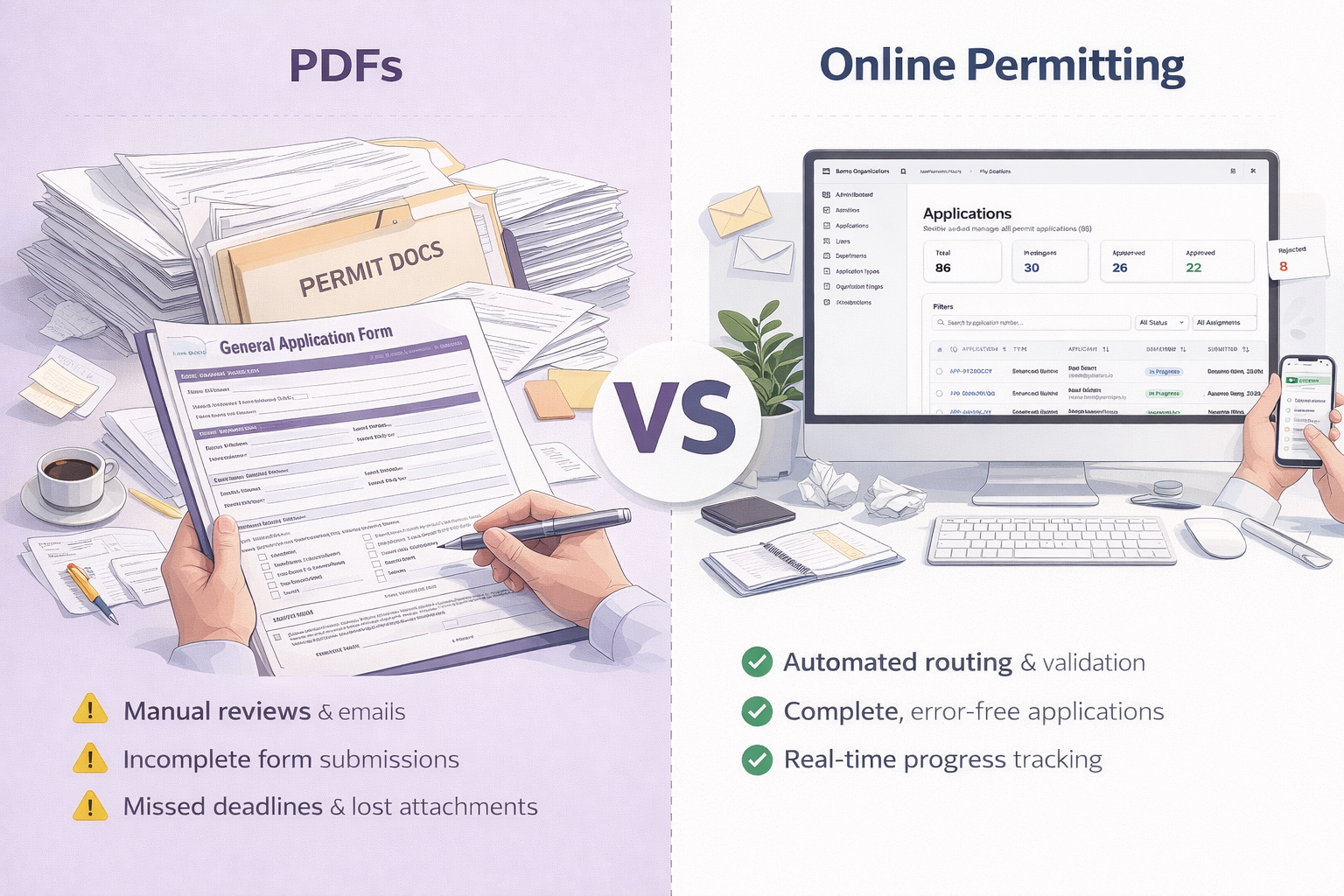
PDF-based permitting slows approvals, increases errors, creates backlogs, and places unnecessary strain on municipal staff. This is why municipalities across Canada are rethinking how permits are submitted, reviewed, and approved — and why modern municipal permitting software is replacing PDFs.
This article explains why PDF permit applications no longer work, how they create inefficiencies across departments, and what modern permitting systems look like today.
Why PDF Permit Applications No Longer Work for Municipalities
PDFs were designed to display information. They were never designed to manage workflows, enforce rules, or scale with growing municipalities.
When PDFs are used as the primary intake method for building permits, planning approvals, and zoning requests, problems appear immediately — and compound over time.
What looks simple on the surface creates friction at every step of the permitting process.
PDF Permit Applications Create Incomplete Submissions by Design
PDF permit applications allow applicants to submit information without guidance or validation.
Applicants can skip required fields, upload incorrect or missing documents, use outdated forms, or misunderstand zoning and bylaw requirements. The system does nothing to stop them.
Because PDFs lack built-in validation, errors are only discovered after submission. Municipal staff are then forced into repeated follow-ups by email or phone, often multiple times for the same application.
The result is predictable: incomplete permit applications become routine, review timelines stretch, and frustration grows for both staff and applicants.
Manual Permit Processing Does Not Scale
With PDF-based permitting, staff must manually review every application, verify documents, cross-check bylaws, and track approvals across departments.
As permit volumes increase, this manual permit processing becomes unsustainable. Reviews slow down, errors increase, and staff spend more time managing paperwork than issuing permits.
Hiring more staff may provide temporary relief, but it does not fix the underlying problem. The process itself is inefficient.
Email-Based Permit Processing Eliminates Visibility and Accountability
In many municipalities, PDF permit applications are submitted and routed entirely through email.
Email-based permit processing creates serious operational blind spots. There is no real-time status tracking, no clear ownership, and no reliable audit trail. Approvals get buried in inboxes, follow-ups depend on memory, and reporting becomes nearly impossible.
For CAOs and city managers, this lack of visibility makes it difficult to answer basic questions such as where permits are getting stuck, which departments are overloaded, or how long approvals actually take.
The Hidden Cost of PDF Permitting: Backlogs, Burnout, and Public Frustration
PDF-based and paper-based permitting systems are a major driver of permit backlogs in municipalities.
Because applications arrive incomplete and compliance checks happen late in the process, reviews take longer than necessary. Staff are forced to recheck the same files repeatedly, while applicants wait weeks or months for updates.
Over time, this leads to staff burnout and erodes public trust in municipal services.
What Modern Municipal Permitting Software Actually Changes
Modern municipal permitting software does not simply digitize PDFs.
It replaces them with structured, rules-based digital workflows designed specifically for local government.
This shift changes how permits move through the entire organization.
Structured Online Permit Applications Replace PDFs
Modern permit application software uses dynamic online forms instead of static PDFs.
These forms guide applicants through the process, enforce required fields, adjust questions based on permit type, and validate information before submission. Missing documents and obvious errors are caught immediately.
The result is simple but powerful: only complete permit applications reach municipal staff.
Automated Compliance and Bylaw Validation
One of the most important advantages of modern e-permitting software is automated compliance.
Zoning rules, setbacks, lot coverage, and land-use requirements can be validated upfront. Obvious non-compliance is flagged instantly, before staff invest time reviewing the file.
This reduces errors, shortens review timelines, and allows staff to focus on complex cases rather than basic checks.
Workflow Automation Across Departments
A modern permit management system automates how permits move through the municipality.
Applications are routed automatically between building, planning, engineering, and fire departments. Reviews can happen in parallel instead of sequentially, and ownership is clearly defined at every stage.
This eliminates many of the workflow inefficiencies caused by email-based handoffs and manual routing.
Real-Time Visibility for Municipal Leadership
Modern municipal operations software provides real-time dashboards showing permit volume, average review times, departmental bottlenecks, and service-level performance.
This visibility allows CAOs and city managers to identify issues early, allocate resources more effectively, and improve service delivery without increasing headcount.
Why Digital Permitting Matters for Canadian Municipalities
Canadian municipalities face growing housing pressure, staff shortages, and rising expectations for digital services.
Digital permitting is no longer a nice-to-have. It is becoming core municipal infrastructure.
Municipal software in Canada must also support Canadian data residency, provincial regulations, and bilingual workflows, particularly in Quebec.
Where PermiPro Fits In
Modern permitting requires more than digitizing forms. It requires rethinking how permits are validated, routed, and approved from day one.
PermiPro was built to help Canadian municipalities move beyond PDFs, email chains, and manual reviews.
The platform replaces static permit applications with structured online forms, automates workflows across departments, and validates submissions against local bylaws before staff ever touch the file.
The result is fewer incomplete applications, faster approvals, and significantly less administrative overhead — without adding staff.
Book a Demo
If your municipality is still processing permits through PDFs or email, there is a better way.
A short demo is often enough to see where time is being lost today — and how a modern permitting platform can remove those bottlenecks.
Book a demo at https://www.permipro.io